Global delivery from Hanoi, Vietnam ISO 9001:2015   ISO 27001:2013 hello@agiletech.vn (+84) 989 324 830

Learning Management System Development

A learning management system is judged by two groups with different tolerances. Learners abandon it quietly if it is confusing on a phone. Educators abandon it loudly if publishing a week of content takes an afternoon. A platform that satisfies an evaluation checklist and neither of those groups is a failed project regardless of its feature list.

10+Years of Industry Expertise 200+Talented Developers 90%Customer Satisfaction Rate
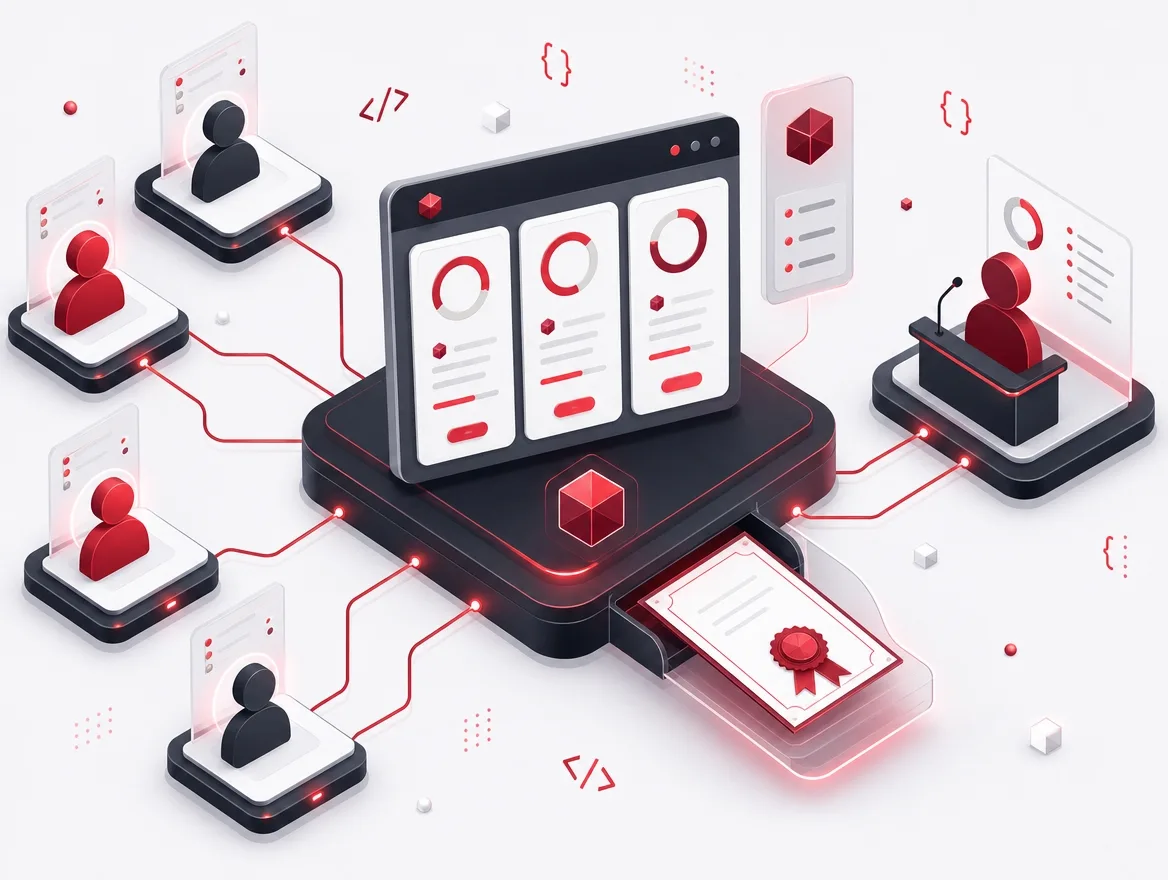
Learning management system linking learners, course content, progress tracking, and certification
ISO 9001:2015 Certified ISO 27001:2013 Certified

What Learning Management Systems Clients Say About AgileTech

Independent reviews from Clutch and DesignRush. Every review below is shown in full and links back to its source platform so you can confirm it yourself.

5.0
Nov 2024

“The platform has greatly improved our operational efficiency, and we wholeheartedly recommend AgileTech.”

Working with AgileTech has been an amazing experience, especially when it comes to creating a personalized e-learning program for our IT services business. We were pleasantly surprised by how adaptable and scalable the platform developed by the AgileTech Team was. Their proficiency with user-friendly course administration and community participation technologies enabled us to provide a thorough instructional resource catered to our customers’ particular requirements. The platform has greatly improved our operational efficiency, and we are amazed by its capacity to manage heavy traffic with ease and offer comprehensive reporting and analytics. The platform remained successful and user-friendly because of the team’s dedication to continuous support and their quick response to criticism. For any organization looking to create innovative and reliable digital solutions, we wholeheartedly recommend AgileTech as a partner.

Personalized e-learning platform that handles heavy traffic

5.0
Nov 2024

“They used a potent tech stack including PHP, React, and AWS to guarantee perfect scalability and zero downtime.”

AgileTech provided a superb Learning Management System (LMS) that creatively and precisely addressed the intricate needs of our organization. Within a scalable, completely customizable platform, the LMS made it possible to create comprehensive courses, administer student tests, engage the community, and obtain real-time data insights. AgileTech’s modular and agile approach made sure that every component, from the user-friendly course builder to the sophisticated analytics and communication tools, was customized to meet our demands despite the difficulties of developing such a feature-rich system. In order to guarantee perfect scalability and zero downtime, even with high user concurrency, AgileTech used a potent tech stack that included PHP, React, and AWS. Their post-launch assistance, which included frequent training sessions and upgrades, gave our staff the means to fully use the LMS’s potential. This project was a testament to AgileTech’s technical skill, rapid deployment, and dedication, making them an outstanding choice for educational technology development.

Feature-rich LMS with course builder, analytics, and comms

4.5
Apr 2021

“They are incredible to work with and are truly passionate about technology and our concept.”

AgileTech Viet Nam provides mobile app development services for a social media startup. They are building the app using Node.js and Flutter. With the ongoing partnership, AgileTech Viet Nam’s passion has impressed the client so far. The team is truly into technology, and their concept makes the client feel confident about the project’s continuous success.

5.0
Jun 2025

“Their proactive communication, flexibility, and technical expertise stood out throughout the project.”

AgileTech Viet Nam used React Native to develop an iOS and Android app for a real estate platform. The team integrated the app with the client’s backend and implemented property search features. AgileTech Viet Nam’s high-quality work resulted in a 30% increase in user registrations and over 1,000 app downloads within the first month. The team delivered on time, provided regular updates, and responded to feedback. Their flexibility and proactive communication impressed the client.

30% more sign-ups and 1,000+ downloads in the first month

5.0
May 2026

“They followed a structured Agile approach with clearly defined milestones.”

AgileTech Viet Nam developed a web-based logistics management system for an automotive parts supplier. The team integrated the platform with third-party providers and built a real-time tracking dashboard. AgileTech Viet Nam’s work reduced manual processing by 55%, improved real-time shipment visibility, and increased operational efficiency across multiple departments. The team followed a structured Agile approach, communicated consistently, delivered on time, and was flexible.

Manual processing reduced by 55% with real-time shipment visibility

5.0
May 2026

“They were not just executing tasks but were genuinely invested in the product’s success.”

AgileTech Viet Nam developed an MVP for a digital solutions provider’s marketplace platform. They created the UI/UX design, developed the front- and backend, and integrated payment systems. AgileTech Viet Nam successfully launched the MVP on time, allowing the client to onboard 500 users within two months. The platform was stable with minimal issues. Moreover, the team was collaborative, flexible, quick to adapt to changing priorities, and genuinely invested in the project’s success.

MVP launched on time, 500 users onboarded within two months

5.0
May 2026

“Their ability to handle both high-level architecture and hands-on implementation is rare.”

An IT services company hired AgileTech Viet Nam to re-architect their enterprise SaaS platform. The team conducted a technical audit, designed a new architecture, migrated legacy data, and added API gateways. Thanks to AgileTech Viet Nam’s work, the client saw improvements in system scalability, platform uptime, and deployment time. The team followed the Agile methodology, communicated effectively, and was responsive to the client’s feedback. AgileTech Viet Nam helped the client make better decisions.

Improved scalability, uptime, and deployment time on an enterprise SaaS

5.0
May 2026

“They were flexible in accommodating evolving business needs while still keeping the project on track.”

AgileTech Viet Nam developed a digital platform for a real estate firm. They designed the UI/UX, implemented advanced search and filtering functionalities, integrated dashboards, and automated reporting tools. The platform improved operational efficiency, business performance, lead conversion rates, and customer responsiveness. AgileTech Viet Nam implemented a well-structured project management approach, meeting timelines and responding to feedback with flexibility. Their tailored solutions stood out.

Improved efficiency, business performance, and lead conversion

4.0
Jun 2019

“I was impressed with the flow of the project.”

AgileTech Viet Nam developed a mobile app from scratch. After helping with scoping and objective formation, AgileTech created design mockups and developed the full iOS and Android solutions. Valuable user data is being gathered in ongoing beta tests, which will soon lead to growth and expansion opportunities. AgileTech Viet Nam provided consistent communication and established a smooth workflow. Issues were raised proactively, allowing fixes to come earlier in the process.

5.0
Nov 2024

“AgileTech excelled in supporting our project from initial mock-ups through to the final delivery on the App Store.”

AgileTech excelled in supporting our project from initial mock-ups through to the final delivery on the App Store, incorporating data analytics that we could easily share with our customers. The scope of work included mock-up creation, UI/UX design, interactive prototyping, app development, rigorous testing, and setting up a secure production environment on AWS, culminating in the apps release on both iOS and Android platforms.

5.0
Nov 2024

“Since we launched our new site we’ve seen a significant increase in traffic and sales, which proves their work is effective.”

We’ve had an amazing experience with AgileTech for our eCommerce platform. The team worked with us to build an user friendly online store that met all our business needs. Their eCommerce development expertise was evident from the start as they shared valuable insights on how to maximize sales. The AgileTech team are not only talented but also care about their clients success. Since we launched our new site we’ve seen a significant increase in traffic and sales which proves their work is effective.

5.0
Nov 2024

“Their attention to detail in web development and UI/UX design has given us a site that looks great and works flawlessly.”

Working with AgileTech has been a game changer for us. We wanted a modern and responsive website and AgileTech delivered more than we expected. The team was super collaborative and involved us in every step of the process. Their attention to detail in web development and UI/UX design has given us a site that looks great and works flawlessly. The AgileTech team members are not only talented professionals but also great communicators, so we could share our vision and ideas easily. They were so committed to our success and the end result has increased our user engagement and satisfaction so much.

5.0
May 2026

“Their balance between technical expertise and product thinking stood out.”

AgileTech Viet Nam developed an AI-powered analytics platform for an AI visibility and GEO solutions company. The platform featured real-time reporting dashboards and data processing pipelines. AgileTech Viet Nam’s work improved the client’s data processing efficiency and the accuracy of AI-generated insights. The platform was user-friendly and supported the client’s first large-scale deployments. AgileTech Viet Nam’s team was communicative, adaptive, and technically proficient.

Improved data-processing efficiency and AI insight accuracy

5.0
Mar 2026

“The team demonstrated strong professionalism, reliability, and a proactive approach throughout the project.”

AgileTech Viet Nam developed a scalable engineering workflow system for an ICT company. The goal was to streamline internal processes, improve cross-team visibility, and enhance coordination. The system significantly improved operational efficiency by reducing manual processes and increasing transparency across teams for the client. AgileTech Viet Nam set clear milestones and provided regular updates to ensure everyone remained in sync. Their professionalism and reliability stood out.

Scalable engineering workflow system with fewer manual processes

5.0
Nov 2024

“We saw huge cost savings and optimized stock levels, so we consider AgileTech a partner in our company transformation.”

AgileTech created a working Supply Chain Management (SCM) system that has helped our supermarket chain simplify operations across inventory management, demand forecasting and logistics. They integrated our existing systems, automated inventory and logistics and gave us robust demand forecasting with AI, we saw huge cost savings and optimized stock levels. And they continued to deliver on quality post launch with regular updates and training sessions, so we consider AgileTech as a partner in our company transformation.

AI-driven demand forecasting across inventory and logistics

5.0
May 2026

“Their professionalism, responsiveness, and ability to execute efficiently made them feel like an operational partner.”

AgileTech Viet Nam optimized a workflow for a consulting firm. The team improved lead management processes and streamlined internal communication systems across multiple departments. AgileTech Viet Nam’s work improved the client’s operations, customer communication process, and overall workflow efficiency. The team was strategic and reliable. Moreover, AgileTech Viet Nam worked closely with the client to understand their business objectives and recommend solutions.

What a Learning Management System Contains

The capability areas that define scope, whether we are building a platform or extending one already in service.

Course Structure and Authoring

Modules and units with sequence, dependency, and release conditions, prerequisites and optional paths, content versioning so a running cohort is unaffected by revisions, reusable templates across courses, and authoring an educator can operate without engineering support.

Content Delivery and Media

Documents, video with adaptive streaming and captions, interactive activity, external tool embedding through LTI, SCORM and xAPI package support for publisher material, and offline or low-bandwidth access for learners whose connection is not dependable.

Enrolment, Cohorts, and Roles

Term intakes, rolling self-enrolment, manager-assigned training, waiting lists, section transfers, mid-term withdrawal and return, and role separation across learner, educator, teaching assistant, observer, and administrator with the access each genuinely needs.

Assessment and Gradebook

Assignments with submission windows and late policy, quizzes, participation and peer review, rubric marking with moderation and second-marker workflow, configurable weighting per course, and result transfer to the student record as the official outcome.

Progress, Analytics, and Early Warning

Completion and mastery tracking against learning outcomes, engagement signals that identify disengagement before it becomes withdrawal, cohort comparison for programme review, and educator dashboards scoped to the classes a person actually teaches.

Credentialing and Compliance Records

Certificate generation on defined completion criteria, verifiable credentials where an employer or regulator must confirm them, expiry and recertification cycles for mandatory training, and audit-ready evidence of who completed what and when.

Systems a Learning Management System Connects To

An LMS sits in the middle of an institution's systems, so its interfaces determine how much administrative work it removes. We establish which system is authoritative for each fact before design.

  • Student information systems: enrolments and cohorts flow in, final results flow back, with the record system remaining authoritative for identity, programme, and the official transcript.
  • Virtual classroom and conferencing: scheduled sessions surfaced inside the course, single-click launch without a second login, and attendance and recordings returned to the course record automatically.
  • Identity providers and single sign-on: SAML or OpenID Connect against an institutional directory, with role and group membership derived from the directory rather than maintained twice.
  • Content publishers and libraries: SCORM and xAPI packages, LTI tool integration, and library or repository links so licensed material is reached in context rather than duplicated.
  • Assessment and proctoring platforms: formal examinations launched from the course and results returned, keeping high-stakes assessment in a system built for it.
  • Finance and fee systems: access conditioned on fee status where an institution requires it, and paid course or programme purchase for commercial providers.
  • HR and learning record systems: for corporate training, staff records and reporting lines drive assignment, and completion posts back to the employee training record.
  • Reporting and data warehouse: activity and outcome data exported for institutional analysis and statutory returns, produced from the platform rather than compiled by hand each cycle.

Technical Considerations for LMS Development

The engineering decisions that determine whether a LMS development project holds up in production, set out before the build starts.

Authoring speed determines whether the platform is used

The most reliable predictor of LMS success is how long it takes an educator to publish a week of material. If that takes twenty minutes, courses stay current and the platform becomes the place teaching happens. If it takes an afternoon, educators revert to email and shared drives, and the platform degrades into a file repository with a gradebook attached. We design the authoring path first and measure it on real content with real educators, rather than assuming the administrative interface will be tolerated because it is comprehensive.

Enrolment state is history, not a flag

Institutions treat enrolment as a simple relationship until the first learner withdraws in week six, returns the following term, and needs a transcript covering both attempts. Enrolment must therefore be a stateful record with effective dates and reasons, so grades, certificates, attendance, and statutory reporting each resolve correctly against the period they describe. Retrofitting this onto a boolean membership model requires reconstructing history that was never recorded, which is one of the more painful remediation projects in education software.

Load arrives in extreme, predictable spikes

Education traffic is unlike commercial traffic. Term start, assignment deadlines, and results release produce concentrated peaks where a large share of the learner population arrives within minutes, and the deadline peak is the least forgiving because a submission that fails is an academic consequence. We design submission handling for that specific moment with queued, acknowledged uploads that survive a slow connection, load-test against deadline profiles rather than average traffic, and scale media delivery separately from application logic since video dominates bandwidth but not computation.

Stack choices we typically recommend

PostgreSQL for course, enrolment, and grade data where relational integrity and history matter. Node.js or Python for the backend, with media transcoding and delivery separated onto object storage and a CDN rather than served by the application. ReactJS for learner and educator interfaces, with Flutter or React Native where a native mobile app with offline content is required. Caching designed around the deadline and term-start profiles, and a background job layer for transcoding, notifications, and report generation.

  • Academic calendar boundaries: releases and migrations are sequenced between terms, because changing a platform mid-term affects assessment that is already underway.
  • Accessibility as a build property: WCAG 2.1 AA verified with assistive technology on each release, since automated checking detects only a fraction of real barriers.
  • Academic integrity boundaries: submission timestamps, version history, and similarity checking integration, with policy decisions kept in institutional hands rather than encoded silently.
  • Minors and parental access: where learners are under age, consent capture, guardian visibility scope, and communication rules are designed in rather than added under pressure.

Who This Is For

Institutions whose delivery model does not fit standard products

Competency-based progression, workplace and apprenticeship learning, clinical or laboratory placement, and heavily modular qualifications all strain platforms designed around a fixed course and cohort. A focused build that matches the actual model often costs less over time than continuous workaround.

Education businesses whose platform is the product

If learners pay you directly, the platform is your commercial surface rather than an internal tool. Enrolment conversion, retention mechanics, content merchandising, and multi-tenant delivery to institutional customers become product requirements that generic platforms do not serve well.

Organisations running mandatory and regulated training

Where completion must be evidenced to a regulator, the requirements shift toward assignment rules, expiry and recertification cycles, verifiable records, and audit trails. That is a compliance system with learning content in it rather than a conventional LMS.

Institutions with a working platform and a missing layer

Where Moodle or Canvas is embedded and functioning, replacement is rarely the answer. A custom learner experience, an integration layer to student records and finance, analytics beyond native reporting, or a mobile app on the platform API delivers the gap without the risk.

How We Deliver LMS Projects

A sequence built around the constraint that an academic term cannot be interrupted for a deployment.

AgileTech software delivery process A six step delivery workflow: requirement analysis, planning and design, development, quality assurance, deployment, then maintenance and support. 01 RequirementAnalysis 02 Planning &Design 03 Development 04 QualityAssurance 05 Deployment 06 Maintenance &Support
01

Delivery Model and Policy Discovery

We document how teaching actually runs: enrolment routes, grading policy per faculty or programme, assessment types, and the variation between departments that generic platforms cannot absorb. We also establish the build-versus-buy position and say plainly when an existing product is the right answer.

02

Record Authority and Integration Mapping

We fix which system owns identity, enrolment, and the official result, then specify each interface with its direction, timing, and failure behaviour. Ambiguity between the LMS and the student record is the most expensive thing to discover after launch.

03

Authoring and Learner Experience Design

We design and time the educator authoring path and the learner journey on mobile before building administrative depth, because a platform that is unpleasant to author or to study on will not be adopted regardless of what else it does.

04

Iterative Build with Educator Validation

Short iterations validated by educators building real course material and learners working on real devices, including low-bandwidth conditions. Accessibility is verified with assistive technology on each release rather than audited at the end.

05

Pilot Cohort and Term-Boundary Rollout

A pilot with one programme or faculty across a full assessment cycle, then phased rollout timed to term boundaries so no cohort changes platform mid-assessment. Deadline-load testing precedes every go-live.

06

Ongoing Ownership and Evolution

Monitoring on submission success and media delivery as well as system health, interface maintenance as connected systems change, and enhancement aligned to the academic calendar rather than dropped into a live term.

Frequently Asked Questions

How is an LMS different from a virtual classroom platform?

By time horizon. An LMS holds the course: its structure, its content, its enrolments, its assessments, and the record of what each learner completed over a term. A virtual classroom platform runs the live hour: the room, the participants, the shared screen, the recording. They are complementary rather than competing, and most institutions need both. The connection between them is a scheduled session that appears inside the course, launches into the room, and returns attendance and the recording to the course record. Our virtual classroom page covers the live side in detail; this page covers the course that surrounds it.

How does an LMS relate to a student information system?

The SIS is the institutional record of record and the LMS is where teaching happens. The SIS holds the person, the programme, the registration, the fee position, and the official transcript. The LMS holds the course content, the activity, the submissions, and the working gradebook. Data flows in a defined direction: enrolments come from the SIS into the LMS, and final results flow back from the LMS to the SIS. Trouble arrives when both systems believe they own the same fact, which is why we fix the authority boundary before either integration is built. The student information system page covers the record side.

Should we build an LMS or use an existing product?

For conventional course delivery, use an existing product, and we will say so before scoping anything. Moodle, Canvas, and the commercial platforms encode years of pedagogical and administrative detail that is not economic to reproduce. Building becomes rational when your delivery model does not fit the course-and-cohort shape those products assume, when you are an education business whose platform is the product you sell, when licensing at your learner volume becomes a strategic cost, or when the actual gap is orchestration across several existing systems. We assess this honestly, including when the answer costs us the engagement.

Can you extend or integrate the LMS we already run?

Frequently that is the better project. An institution with a working Moodle or Canvas installation rarely needs a replacement; it needs capability the platform does not offer, delivered around it. That may be a custom learner experience over the platform's data, an integration layer to the student record and finance systems, analytics the native reporting cannot produce, or a mobile application built on the platform's API. We work with LTI where the platform supports it, which lets custom tools appear inside the course without either system absorbing the other.

What does course structure and content delivery actually involve?

More than uploading files. A course needs a structure that expresses sequence and dependency: modules that unlock on completion or date, prerequisites, optional and required paths, and versioning so the cohort running now is not disturbed when next term's content is revised. Content itself spans documents, video, interactive activity, external tools, and often SCORM or xAPI packages from third-party publishers. The design question that determines quality is whether an educator can build and revise a course without a developer, because a platform that needs engineering support for content changes stops being used.

How are cohorts, enrolment, and access handled?

Enrolment is where most LMS complexity actually lives, because real institutions do not enrol learners in one simple way. There are cohort intakes tied to a term, rolling self-enrolment, manager-assigned corporate training, waiting lists, transfers between sections, withdrawals mid-term, and audit or observer access for staff and sometimes parents. Each carries consequences for grades, certificates, and reporting. We model enrolment as a stateful record with history rather than a flag, so a learner who withdrew in week six and returned next term does not corrupt either cohort's data.

How do assessment and the gradebook work?

The LMS gradebook handles continuous assessment: assignments with submission windows and late policies, quizzes, participation, peer review, and rubric-based marking with moderation where a second marker is required. Weighting and calculation rules have to be configurable per course, because grading policy differs by institution, faculty, and sometimes individual programme. Formal examinations with item banks and proctoring are a separate problem with separate requirements, covered on our assessment and examination platform page. Final results transfer to the student record system as the official outcome.

Can it support adaptive or AI-assisted learning?

Yes, and the useful version is narrower than the marketing. What works reliably is adaptive sequencing driven by assessment evidence, so a learner who demonstrates mastery skips ahead and one who does not is routed to remediation, plus early-warning signals from engagement and submission patterns that let a tutor intervene before a learner disengages. Language-model assistance is genuinely useful for draft feedback, question generation, and content summarisation, always with an educator reviewing output before it reaches a learner. We build these as features of the platform rather than as a separate product, and we do not present statistical inference as pedagogical certainty.

What about accessibility and mobile access?

Accessibility is a functional requirement in education, not a refinement, and in many jurisdictions a legal obligation for publicly funded institutions. We build to WCAG 2.1 AA: keyboard operability throughout, screen reader semantics, sufficient contrast, captions and transcripts for media, and no reliance on colour alone to convey meaning. We test with assistive technology rather than only with automated checkers, which catch a minority of real barriers. We do not claim WCAG certification, because conformance is a property of a specific build that requires ongoing verification, and we tell you plainly which criteria a release meets. Mobile matters because a large share of learners study on a phone, so we treat responsive behaviour and offline content access as core rather than optional.

How long does an LMS project take?

A focused first release covering course structure, content delivery, enrolment, assignment submission, and a working gradebook is typically four to eight months including discovery, integration, and a pilot cohort. Timelines are shaped less by feature count than by two things: the quality of the student record integration, and how much variation exists in grading and enrolment policy across the institution. Where policy is consistent and the record system has a usable API, delivery is fast. Where every faculty grades differently, that configuration work leads the schedule.

How do you handle learner data and privacy?

Learner data, particularly for minors, carries obligations that vary sharply by jurisdiction. We build to the requirements that apply to you: lawful basis and consent capture, data minimisation, role-based access with audit logging, defined retention and deletion, parental consent and access mechanics where learners are under age, and encryption in transit and at rest. Our information security management is certified to ISO 27001:2013 and quality management to ISO 9001:2015. We do not describe ourselves as a FERPA or COPPA certified vendor, because no such certification exists for software suppliers; those obligations rest with the institution, and our role is to build so you can meet them and evidence it.

Trusted and Recognized

Independent directories, certification bodies, and award programs that have assessed our work. Each badge links to its source or names the standard behind it, so every claim on this page can be checked at first hand.

Top Mobile App Developers - ClutchTop Software Development Company - GoodFirmsReliable Company - ExtractISO 9001:2015 certifiedISO 27001:2013 certifiedTechBehemoths Awards - Mobile App Development

Ready to Discuss Your Learning Management System Project?

Tell us what platform you run today, how much grading policy varies by faculty, and what your educators cannot do. We will come back with a straight assessment of build versus integrate, a delivery sequence, and an estimate within 48 hours.

Life at AgileTech

Consult Industry Specialists

Connect with us today to discuss your software development needs and discover how our tailored outsourcing services can propel your business forward.

Start a conversation
AgileTech Vietnam team at the office

Cookie settings

Strictly necessary storage keeps the site working and remembers this choice. Everything else is off until you switch it on, wherever you are in the world. Only one optional category has anything behind it today: External content, which covers the Google map of our Hanoi office on the Contact page.

Wherever you are. We apply one standard to everyone: nothing outside strictly necessary storage runs until you allow it. That meets the EU and UK requirement for prior consent, the notification and consent requirements of Singapore's PDPA, and US state privacy law. You can withdraw or change your choice at any time, as easily as you gave it, from Cookie settings in the footer.

If you are in the United States. We do not sell your personal information and we do not share it for cross-context behavioural advertising, so there is nothing to opt out of. We still honour an opt-out preference signal from your browser: if your browser sends Global Privacy Control, the optional categories stay off without you having to do anything.

Full detail, including the name and lifetime of the one cookie we set, is in the Cookie Policy.