Global delivery from Hanoi, Vietnam ISO 9001:2015   ISO 27001:2013 hello@agiletech.vn (+84) 989 324 830

Inventory Management Software Development

Inventory accuracy is the constraint under almost every other retail problem. Overselling, disappointed collections, emergency transfers, and dead stock all trace back to systems that disagree about what is actually on the shelf. We build the stock layer that ends the disagreement: one ledger of movements, explicit reservations, and every channel reading the same position.

10+Years of Industry Expertise 200+Talented Developers 90%Customer Satisfaction Rate
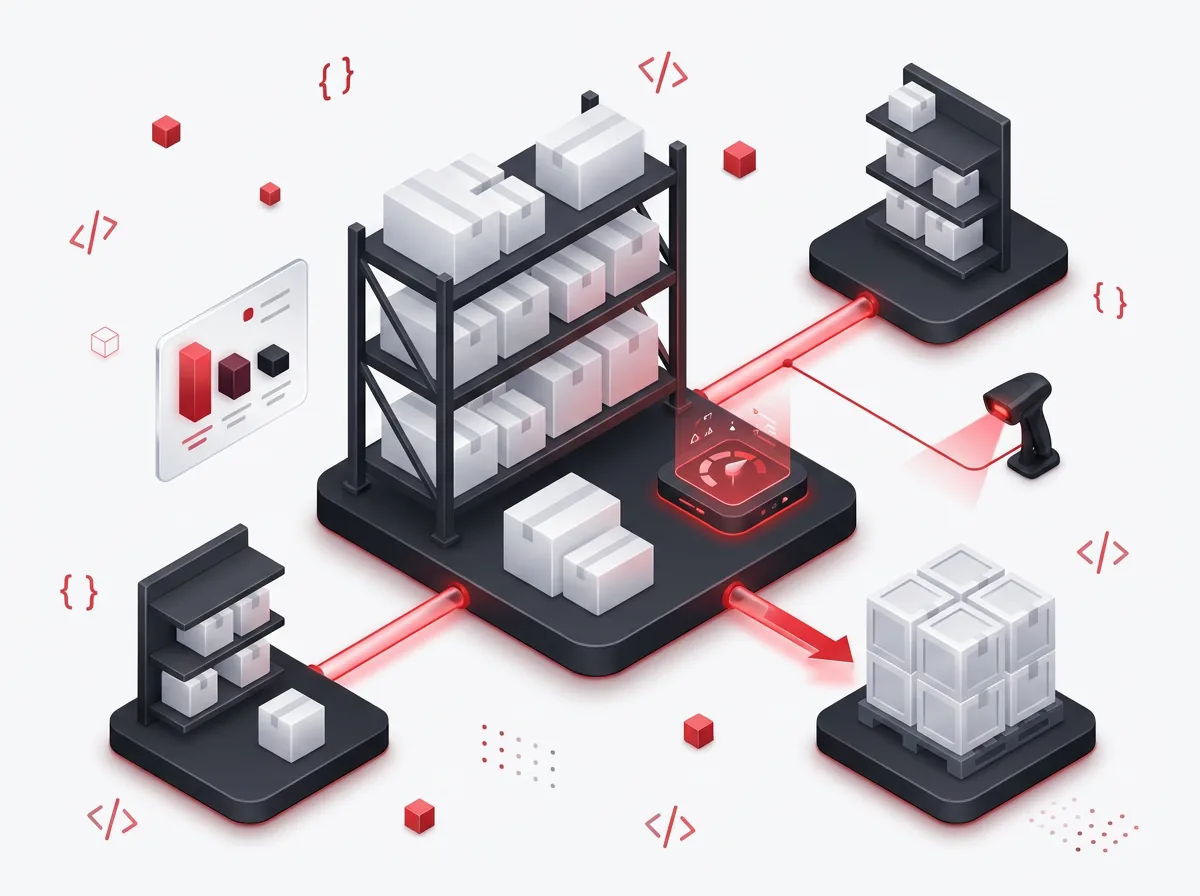
Inventory management system tracking stock movements across warehouse and store locations
ISO 9001:2015 Certified ISO 27001:2013 Certified

What Inventory Management Clients Say About AgileTech

Independent reviews from Clutch and DesignRush. Every review below is shown in full and links back to its source platform so you can confirm it yourself.

5.0
Nov 2024

“Since we launched our new site we’ve seen a significant increase in traffic and sales, which proves their work is effective.”

We’ve had an amazing experience with AgileTech for our eCommerce platform. The team worked with us to build an user friendly online store that met all our business needs. Their eCommerce development expertise was evident from the start as they shared valuable insights on how to maximize sales. The AgileTech team are not only talented but also care about their clients success. Since we launched our new site we’ve seen a significant increase in traffic and sales which proves their work is effective.

5.0
May 2026

“They were not just executing tasks but were genuinely invested in the product’s success.”

AgileTech Viet Nam developed an MVP for a digital solutions provider’s marketplace platform. They created the UI/UX design, developed the front- and backend, and integrated payment systems. AgileTech Viet Nam successfully launched the MVP on time, allowing the client to onboard 500 users within two months. The platform was stable with minimal issues. Moreover, the team was collaborative, flexible, quick to adapt to changing priorities, and genuinely invested in the project’s success.

MVP launched on time, 500 users onboarded within two months

5.0
Nov 2024

“We saw huge cost savings and optimized stock levels, so we consider AgileTech a partner in our company transformation.”

AgileTech created a working Supply Chain Management (SCM) system that has helped our supermarket chain simplify operations across inventory management, demand forecasting and logistics. They integrated our existing systems, automated inventory and logistics and gave us robust demand forecasting with AI, we saw huge cost savings and optimized stock levels. And they continued to deliver on quality post launch with regular updates and training sessions, so we consider AgileTech as a partner in our company transformation.

AI-driven demand forecasting across inventory and logistics

5.0
Jun 2025

“Their proactive communication, flexibility, and technical expertise stood out throughout the project.”

AgileTech Viet Nam used React Native to develop an iOS and Android app for a real estate platform. The team integrated the app with the client’s backend and implemented property search features. AgileTech Viet Nam’s high-quality work resulted in a 30% increase in user registrations and over 1,000 app downloads within the first month. The team delivered on time, provided regular updates, and responded to feedback. Their flexibility and proactive communication impressed the client.

30% more sign-ups and 1,000+ downloads in the first month

5.0
May 2026

“They followed a structured Agile approach with clearly defined milestones.”

AgileTech Viet Nam developed a web-based logistics management system for an automotive parts supplier. The team integrated the platform with third-party providers and built a real-time tracking dashboard. AgileTech Viet Nam’s work reduced manual processing by 55%, improved real-time shipment visibility, and increased operational efficiency across multiple departments. The team followed a structured Agile approach, communicated consistently, delivered on time, and was flexible.

Manual processing reduced by 55% with real-time shipment visibility

5.0
May 2026

“Their ability to handle both high-level architecture and hands-on implementation is rare.”

An IT services company hired AgileTech Viet Nam to re-architect their enterprise SaaS platform. The team conducted a technical audit, designed a new architecture, migrated legacy data, and added API gateways. Thanks to AgileTech Viet Nam’s work, the client saw improvements in system scalability, platform uptime, and deployment time. The team followed the Agile methodology, communicated effectively, and was responsive to the client’s feedback. AgileTech Viet Nam helped the client make better decisions.

Improved scalability, uptime, and deployment time on an enterprise SaaS

5.0
May 2026

“Their balance between technical expertise and product thinking stood out.”

AgileTech Viet Nam developed an AI-powered analytics platform for an AI visibility and GEO solutions company. The platform featured real-time reporting dashboards and data processing pipelines. AgileTech Viet Nam’s work improved the client’s data processing efficiency and the accuracy of AI-generated insights. The platform was user-friendly and supported the client’s first large-scale deployments. AgileTech Viet Nam’s team was communicative, adaptive, and technically proficient.

Improved data-processing efficiency and AI insight accuracy

5.0
May 2026

“They were flexible in accommodating evolving business needs while still keeping the project on track.”

AgileTech Viet Nam developed a digital platform for a real estate firm. They designed the UI/UX, implemented advanced search and filtering functionalities, integrated dashboards, and automated reporting tools. The platform improved operational efficiency, business performance, lead conversion rates, and customer responsiveness. AgileTech Viet Nam implemented a well-structured project management approach, meeting timelines and responding to feedback with flexibility. Their tailored solutions stood out.

Improved efficiency, business performance, and lead conversion

5.0
Mar 2026

“The team demonstrated strong professionalism, reliability, and a proactive approach throughout the project.”

AgileTech Viet Nam developed a scalable engineering workflow system for an ICT company. The goal was to streamline internal processes, improve cross-team visibility, and enhance coordination. The system significantly improved operational efficiency by reducing manual processes and increasing transparency across teams for the client. AgileTech Viet Nam set clear milestones and provided regular updates to ensure everyone remained in sync. Their professionalism and reliability stood out.

Scalable engineering workflow system with fewer manual processes

5.0
Nov 2024

“The platform has greatly improved our operational efficiency, and we wholeheartedly recommend AgileTech.”

Working with AgileTech has been an amazing experience, especially when it comes to creating a personalized e-learning program for our IT services business. We were pleasantly surprised by how adaptable and scalable the platform developed by the AgileTech Team was. Their proficiency with user-friendly course administration and community participation technologies enabled us to provide a thorough instructional resource catered to our customers’ particular requirements. The platform has greatly improved our operational efficiency, and we are amazed by its capacity to manage heavy traffic with ease and offer comprehensive reporting and analytics. The platform remained successful and user-friendly because of the team’s dedication to continuous support and their quick response to criticism. For any organization looking to create innovative and reliable digital solutions, we wholeheartedly recommend AgileTech as a partner.

Personalized e-learning platform that handles heavy traffic

5.0
Nov 2024

“They used a potent tech stack including PHP, React, and AWS to guarantee perfect scalability and zero downtime.”

AgileTech provided a superb Learning Management System (LMS) that creatively and precisely addressed the intricate needs of our organization. Within a scalable, completely customizable platform, the LMS made it possible to create comprehensive courses, administer student tests, engage the community, and obtain real-time data insights. AgileTech’s modular and agile approach made sure that every component, from the user-friendly course builder to the sophisticated analytics and communication tools, was customized to meet our demands despite the difficulties of developing such a feature-rich system. In order to guarantee perfect scalability and zero downtime, even with high user concurrency, AgileTech used a potent tech stack that included PHP, React, and AWS. Their post-launch assistance, which included frequent training sessions and upgrades, gave our staff the means to fully use the LMS’s potential. This project was a testament to AgileTech’s technical skill, rapid deployment, and dedication, making them an outstanding choice for educational technology development.

Feature-rich LMS with course builder, analytics, and comms

5.0
May 2026

“Their professionalism, responsiveness, and ability to execute efficiently made them feel like an operational partner.”

AgileTech Viet Nam optimized a workflow for a consulting firm. The team improved lead management processes and streamlined internal communication systems across multiple departments. AgileTech Viet Nam’s work improved the client’s operations, customer communication process, and overall workflow efficiency. The team was strategic and reliable. Moreover, AgileTech Viet Nam worked closely with the client to understand their business objectives and recommend solutions.

4.5
Apr 2021

“They are incredible to work with and are truly passionate about technology and our concept.”

AgileTech Viet Nam provides mobile app development services for a social media startup. They are building the app using Node.js and Flutter. With the ongoing partnership, AgileTech Viet Nam’s passion has impressed the client so far. The team is truly into technology, and their concept makes the client feel confident about the project’s continuous success.

4.0
Jun 2019

“I was impressed with the flow of the project.”

AgileTech Viet Nam developed a mobile app from scratch. After helping with scoping and objective formation, AgileTech created design mockups and developed the full iOS and Android solutions. Valuable user data is being gathered in ongoing beta tests, which will soon lead to growth and expansion opportunities. AgileTech Viet Nam provided consistent communication and established a smooth workflow. Issues were raised proactively, allowing fixes to come earlier in the process.

5.0
Nov 2024

“AgileTech excelled in supporting our project from initial mock-ups through to the final delivery on the App Store.”

AgileTech excelled in supporting our project from initial mock-ups through to the final delivery on the App Store, incorporating data analytics that we could easily share with our customers. The scope of work included mock-up creation, UI/UX design, interactive prototyping, app development, rigorous testing, and setting up a secure production environment on AWS, culminating in the apps release on both iOS and Android platforms.

5.0
Nov 2024

“Their attention to detail in web development and UI/UX design has given us a site that looks great and works flawlessly.”

Working with AgileTech has been a game changer for us. We wanted a modern and responsive website and AgileTech delivered more than we expected. The team was super collaborative and involved us in every step of the process. Their attention to detail in web development and UI/UX design has given us a site that looks great and works flawlessly. The AgileTech team members are not only talented professionals but also great communicators, so we could share our vision and ideas easily. They were so committed to our success and the end result has increased our user engagement and satisfaction so much.

What a Retail Inventory System Contains

The capability areas that define scope, whether we are building a stock layer from scratch or putting one in front of systems you already run.

Stock Ledger and Movement Model

One authoritative position per item per location, derived from an append-only movement log covering sales, returns, receipts, picks, transfers, adjustments, and write-offs. Every change is attributable to a user, a channel, and a reason, which is what makes shrinkage investigable rather than merely visible.

Reservations and Channel Allocation

Explicit distinction between on hand, available, and sellable, with reservations held at the moment of commitment, expiry on abandoned baskets, per-channel buffers on high-risk lines, and allocation rules that decide which location serves which order.

Replenishment and Purchasing

Reorder points and safety stock from sales velocity and supplier lead time, coverage targets by category, minimum order quantity and case size handling, supplier catalogues and price lists, and suggested purchase orders a buyer reviews with the reasoning visible.

Transfers and Inbound Receiving

Transfer request, dispatch, in-transit position, and receipt with discrepancy handling, plus goods-in against purchase orders, partial and over-delivery, quality rejection, and putaway, so stock in motion is never invisible between two locations.

Counting and Accuracy Control

Cycle count scheduling weighted by value and movement, mobile blind counting, variance review with approval thresholds, adjustment reasons, and accuracy trended by location and category so stock integrity becomes a managed metric instead of an annual event.

Reporting, Ageing, and Markdown

Stock value and cover by category and location, slow-moving and ageing analysis, sell-through against intake, shrinkage by cause, and markdown candidates identified early enough to protect margin rather than after the season has closed.

Systems the Stock Ledger Connects To

A stock ledger is only authoritative if everything that moves stock writes to it. We map every writer and reader before design, because an unmapped one is exactly where the drift will come from.

  • Point of sale: sale, return, and adjustment movements from every lane, queued locally when the store is offline and replayed in order on reconnect so no movement is lost.
  • Ecommerce and marketplaces: sellable position published outward and reservations placed inward, with per-channel buffers, since marketplace penalties for overselling are commercial and immediate.
  • Order management: allocation and fulfilment decisions read location-level availability, which is what makes ship-from-store and click-and-collect promises safe to make.
  • Warehouse and 3PL systems: receipts, picks, packs, and returns, whether handled in your own warehouse or by a logistics provider posting movements through an API or scheduled file.
  • Suppliers and purchasing: catalogues, price lists, lead times, purchase order transmission, and advance shipping notices so inbound stock is visible before it arrives at the door.
  • ERP and finance: stock valuation, cost of goods, and adjustment posting in the form your finance team reconciles, with the valuation method agreed before implementation rather than discovered at audit.
  • Product information: product and variant identity, units of measure, case and pack structure, and barcode data, since stock cannot be tracked reliably against an inconsistent product record.
  • Handheld and scanning devices: receiving, counting, transfers, and shelf enquiry on rugged handhelds or phones, designed for one-handed use on the shop floor rather than a desk.

Technical Considerations for Inventory Systems

The engineering decisions that determine whether a inventory management project holds up in production, set out before the build starts.

Movements, never overwritten quantities

The single most consequential design decision is whether stock is a number that systems set or a position derived from recorded movements. Setting a number means the last writer wins, concurrent updates silently destroy each other, and no one can explain how a figure changed. An append-only movement log gives you a current position, a full history, attribution for every change, and the ability to replay after an outage. Every reliable inventory system we have worked on takes the second approach.

Concurrency is the real failure mode

Two customers reaching the last unit within the same second is the case that decides whether the system is trusted. That requires reservation at the point of commitment, an atomic check-and-hold rather than a read followed by a write, idempotent handling of retried requests, and queued rather than dropped writes under load. These behaviours are only observable under concurrent load testing, so it is designed for and tested deliberately rather than assumed.

Every channel must survive losing the ledger

A store cannot stop selling and a website should not stop taking orders because the central stock service is unavailable. Each channel needs a defined degraded mode: cached position with a conservative buffer, locally queued movements, and ordered replay with clear conflict rules on recovery. What the system does when a dependency is down matters more in retail than how elegantly it behaves when everything is healthy.

Stack choices we typically recommend

PostgreSQL for the movement log and derived positions where transactional integrity is essential, with a cache layer for the high-read availability lookups that storefronts hammer. Backend in Node.js, Python, or Java with a message queue for channel synchronisation and replay. Handheld interfaces as progressive web apps or native applications with offline capability. AWS or Azure hosting, with alerting on accuracy and reconciliation drift rather than only on uptime.

  • Valuation method: FIFO, weighted average, or standard cost is a finance decision with a real implementation cost, so it is agreed before build rather than adjusted afterwards.
  • Unit of measure integrity: eaches, packs, cases, and weights must convert consistently everywhere, because a single ambiguous unit of measure produces recurring phantom variance.
  • Historical accuracy: the ability to reconstruct the stock position at any past date, which matters for audit, dispute resolution, and understanding how a discrepancy actually arose.
  • Data migration: opening balances are established by a controlled count rather than imported from a system whose accuracy is the reason for the project.

Who This Is For

Retailers overselling across channels

If online orders are cancelled because the item was already sold in store, or marketplace performance is penalised for unfulfilled orders, the cause is a stock position that channels do not share. This is the most common and most quickly repaid inventory project.

Multi-location operators without cross-site visibility

When staff phone other stores to check stock, transfers are arranged informally, and stock in transit is invisible, the group is carrying more inventory than it needs to hold service levels. Location-level positions and transfer workflow address that directly.

Businesses whose ERP stock module cannot keep pace

ERP stock modules are often designed around batch processing rather than the real-time reservation traffic that multichannel selling generates. A purpose-built stock layer in front of the ERP is a legitimate and common architecture, not a workaround.

Operators whose stock accuracy is unknown

If you cannot state your current accuracy rate by location, you cannot manage it. Attributable movements plus cycle counting turn stock integrity into a measured trend that responds to intervention.

How We Deliver Inventory Projects

A sequence built around the constraint that trading cannot pause while software is deployed.

AgileTech software delivery process A six step delivery workflow: requirement analysis, planning and design, development, quality assurance, deployment, then maintenance and support. 01 RequirementAnalysis 02 Planning &Design 03 Development 04 QualityAssurance 05 Deployment 06 Maintenance &Support
01

Movement and Ownership Mapping

We trace every event that changes stock, in every system and every manual process, and identify which of them currently believe they own the number. The overlaps found here are usually the direct cause of the inaccuracy.

02

Ledger and Reservation Design

We define the movement types, location structure, and the precise meaning of on hand, available, and sellable, then agree reservation and buffer rules per channel. These definitions are the contract every integration is later built against.

03

Integration Feasibility Assessment

We confirm what each till, storefront, marketplace, warehouse, and ERP can actually read and write, including behaviour when unavailable. Feasibility is verified against the live systems before the delivery plan is committed.

04

Ledger Build and Channel Connection

The movement log and position service are built and hardened first, then channels are connected one at a time, each shadowed against the existing figures until the new position is demonstrably the more accurate one.

05

Concurrency, Peak, and Recovery Testing

Concurrent contention on last-unit items, sustained peak write volume, channel outage and replay, and reconciliation after simulated failure. Accuracy is validated against a physical count rather than against another system.

06

Controlled Cutover and Accuracy Monitoring

Opening balances established by a controlled count, one location live first, then staged rollout. Ongoing support includes accuracy and drift monitoring so a developing problem is visible while it is still small.

Frequently Asked Questions

Why is our stock count wrong even though we have a system?

Almost always because more than one system believes it owns the stock number. The till decrements it, the website reserves it, the warehouse adjusts it, and a marketplace pushes its own figure, each writing an absolute quantity rather than recording a movement. The fix is architectural rather than procedural: one authoritative stock ledger that every channel writes movements into, with reservations held explicitly, so the current position is always derivable and every change is attributable. Discipline alone will not repair a design where ownership is ambiguous.

What is the difference between available, on hand, and sellable stock?

On hand is what is physically present. Available is on hand minus what is already committed to picked orders, click-and-collect holds, and transfers in progress. Sellable is available minus whatever buffer you deliberately withhold from a channel to protect service levels. Overselling happens when a channel is shown on hand instead of sellable. Getting these three definitions explicit, agreed, and implemented consistently removes a large share of oversell incidents on its own.

Can you connect the inventory system to our tills and our website?

Yes, and that is usually the point of the project. The till writes sale, return, and adjustment movements. The website and marketplaces read the sellable position and place reservations at checkout. The warehouse writes receipts, picks, and transfers. Each connection is designed for the failure case as well as the happy path, because a channel that cannot reach the ledger must still trade and then reconcile rather than silently drift.

How do you handle stock across multiple locations?

Every location, whether a store, warehouse, dark store, or supplier-held position, is a distinct stock location in the ledger with its own position. That is what makes cross-store visibility, ship-from-store, transfer suggestion, and allocation decisions possible. Group-level totals are then a rollup rather than a separate number that has to be kept in step, which is where single-total designs eventually fail.

Can the system suggest what to reorder?

Yes. Reorder points and safety stock derived from sales velocity and supplier lead time, coverage targets by category, minimum order quantities and case sizes, and suggested purchase orders a buyer approves rather than executes blindly. We keep the suggestion transparent, showing why a quantity was proposed, because buyers reject recommendations they cannot interrogate and then the feature quietly goes unused.

Do we need barcodes, RFID, or serial number tracking?

Barcodes are the practical baseline and cover most retail cases. Serial or batch tracking is necessary for warranty, recall, expiry, or high-value goods, and it changes the data model because you are then tracking individual units rather than counts. RFID improves count speed and accuracy at scale but carries tagging cost and infrastructure. We size this to your goods and your loss profile rather than defaulting to the most sophisticated option.

How do you manage stocktaking and cycle counting?

Continuous cycle counting rather than one annual shutdown: count schedules weighted by value and movement, mobile counting on a handheld or phone, blind counts so the expected figure does not bias the counter, variance review with approval thresholds, and adjustments recorded as attributable movements. Accuracy is then a measurable trend by location and category rather than an annual surprise.

Does this replace our ERP?

No, and we will say so plainly if you are describing an ERP project. If your requirement spans finance, procurement, and production alongside stock, that is ERP territory and we have a dedicated ERP practice. A retail inventory system is worth building or extending when the ERP's stock module cannot keep pace with real-time multichannel selling, which is a common and legitimate reason to put a purpose-built stock layer in front of it.

How do you prevent overselling during a sale or peak period?

Reservations at the point of commitment rather than at fulfilment, short expiry on abandoned baskets so held stock returns to the pool, per-channel sellable buffers on high-risk lines, and write paths that queue rather than fail under load so no movement is lost. We then load test against a realistic peak, since overselling is a concurrency problem and concurrency problems only appear at volume.

How long does an inventory project take?

A focused stock ledger with till and ecommerce integration typically reaches a production-ready first release in three to five months. Adding replenishment, transfers, multi-location allocation, and counting workflows extends that. We sequence it so the ledger and its integrations go live and prove accurate first, because every later capability depends on that foundation being trusted.

What engagement models are available?

We offer a Dedicated Development Team for continuous product work and Staff Augmentation to extend your in-house team. AgileTech Vietnam brings 10+ years of experience and 200+ developers, with quality management certified to ISO 9001:2015 and information security to ISO 27001:2013. Share your requirements and we prepare a tailored proposal within 48 hours covering team composition, timeline, and cost.

Trusted and Recognized

Independent directories, certification bodies, and award programs that have assessed our work. Each badge links to its source or names the standard behind it, so every claim on this page can be checked at first hand.

Top Mobile App Developers - ClutchTop Software Development Company - GoodFirmsReliable Company - ExtractISO 9001:2015 certifiedISO 27001:2013 certifiedTechBehemoths Awards - Mobile App Development

Ready to Discuss Your Inventory Management Software Project?

Tell us how many locations hold stock, which system owns the count today, and where the numbers disagree. We will come back with a straight assessment of build versus integrate, a delivery sequence, and an estimate within 48 hours.

AgileTech Vietnam team

Consult Industry Specialists

Connect with us today to discuss your software development needs and discover how our tailored outsourcing services can propel your business forward.

Start a conversation
AgileTech Vietnam team at the office

Cookie settings

Strictly necessary storage keeps the site working and remembers this choice. Everything else is off until you switch it on, wherever you are in the world. Only one optional category has anything behind it today: External content, which covers the Google map of our Hanoi office on the Contact page.

Wherever you are. We apply one standard to everyone: nothing outside strictly necessary storage runs until you allow it. That meets the EU and UK requirement for prior consent, the notification and consent requirements of Singapore's PDPA, and US state privacy law. You can withdraw or change your choice at any time, as easily as you gave it, from Cookie settings in the footer.

If you are in the United States. We do not sell your personal information and we do not share it for cross-context behavioural advertising, so there is nothing to opt out of. We still honour an opt-out preference signal from your browser: if your browser sends Global Privacy Control, the optional categories stay off without you having to do anything.

Full detail, including the name and lifetime of the one cookie we set, is in the Cookie Policy.