Global delivery from Hanoi, Vietnam ISO 9001:2015   ISO 27001:2013 hello@agiletech.vn (+84) 989 324 830

Transportation Management System Development

A transportation management system decides how freight moves and what it costs, and it is judged on whether the invoice matches the quote. That sounds like a finance concern. It is the whole system. A TMS that plans a beautiful route and then cannot explain a fuel surcharge three weeks later has failed at the only part the business measures.

10+Years of Industry Expertise 200+Talented Developers 90%Customer Satisfaction Rate
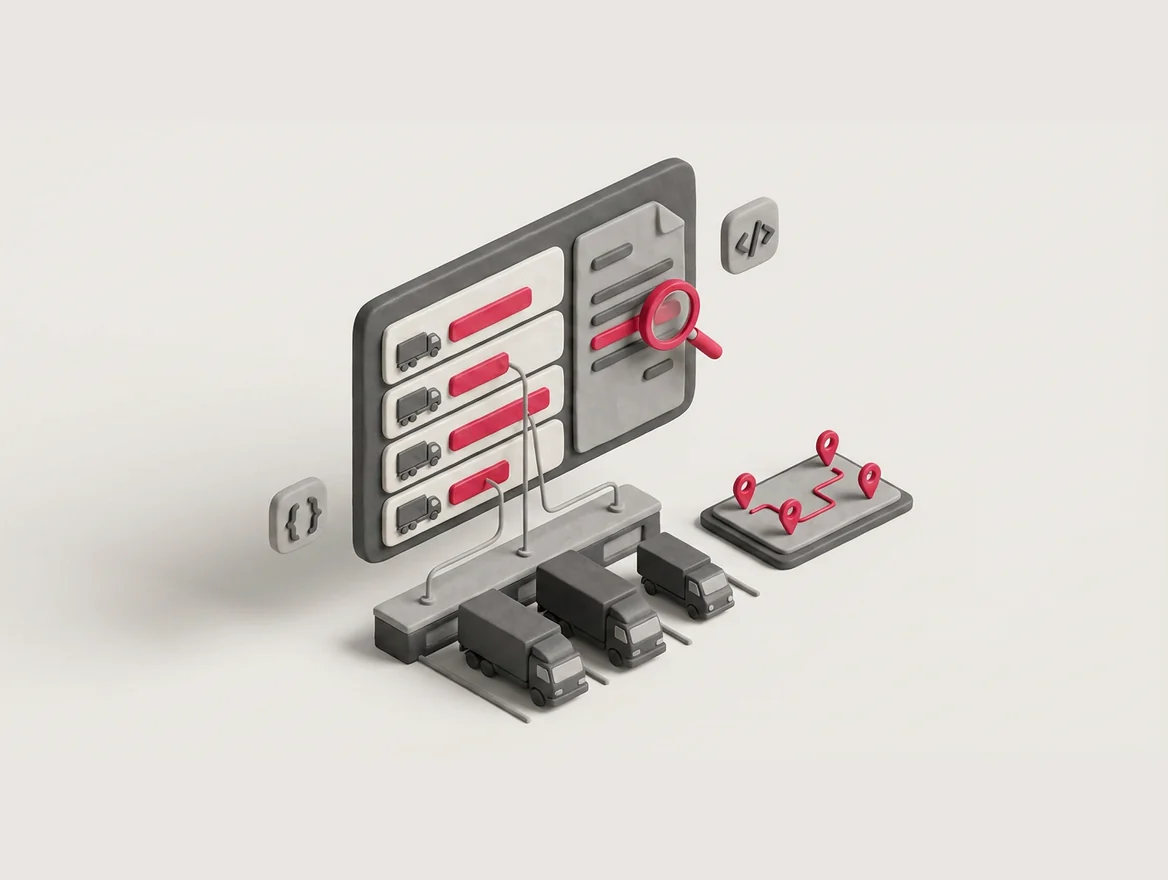
Freight planning board of lanes and costs beside a freight invoice under inspection, with lorries at a loading bay and a routed map
ISO 9001:2015 Certified ISO 27001:2013 Certified

What Transportation Management Clients Say About AgileTech

Independent reviews from Clutch and DesignRush. Every review below is shown in full and links back to its source platform so you can confirm it yourself.

5.0
May 2026

“They followed a structured Agile approach with clearly defined milestones.”

AgileTech Viet Nam developed a web-based logistics management system for an automotive parts supplier. The team integrated the platform with third-party providers and built a real-time tracking dashboard. AgileTech Viet Nam’s work reduced manual processing by 55%, improved real-time shipment visibility, and increased operational efficiency across multiple departments. The team followed a structured Agile approach, communicated consistently, delivered on time, and was flexible.

Manual processing reduced by 55% with real-time shipment visibility

5.0
Nov 2024

“We saw huge cost savings and optimized stock levels, so we consider AgileTech a partner in our company transformation.”

AgileTech created a working Supply Chain Management (SCM) system that has helped our supermarket chain simplify operations across inventory management, demand forecasting and logistics. They integrated our existing systems, automated inventory and logistics and gave us robust demand forecasting with AI, we saw huge cost savings and optimized stock levels. And they continued to deliver on quality post launch with regular updates and training sessions, so we consider AgileTech as a partner in our company transformation.

AI-driven demand forecasting across inventory and logistics

5.0
Jun 2025

“Their proactive communication, flexibility, and technical expertise stood out throughout the project.”

AgileTech Viet Nam used React Native to develop an iOS and Android app for a real estate platform. The team integrated the app with the client’s backend and implemented property search features. AgileTech Viet Nam’s high-quality work resulted in a 30% increase in user registrations and over 1,000 app downloads within the first month. The team delivered on time, provided regular updates, and responded to feedback. Their flexibility and proactive communication impressed the client.

30% more sign-ups and 1,000+ downloads in the first month

5.0
May 2026

“They were not just executing tasks but were genuinely invested in the product’s success.”

AgileTech Viet Nam developed an MVP for a digital solutions provider’s marketplace platform. They created the UI/UX design, developed the front- and backend, and integrated payment systems. AgileTech Viet Nam successfully launched the MVP on time, allowing the client to onboard 500 users within two months. The platform was stable with minimal issues. Moreover, the team was collaborative, flexible, quick to adapt to changing priorities, and genuinely invested in the project’s success.

MVP launched on time, 500 users onboarded within two months

5.0
May 2026

“Their ability to handle both high-level architecture and hands-on implementation is rare.”

An IT services company hired AgileTech Viet Nam to re-architect their enterprise SaaS platform. The team conducted a technical audit, designed a new architecture, migrated legacy data, and added API gateways. Thanks to AgileTech Viet Nam’s work, the client saw improvements in system scalability, platform uptime, and deployment time. The team followed the Agile methodology, communicated effectively, and was responsive to the client’s feedback. AgileTech Viet Nam helped the client make better decisions.

Improved scalability, uptime, and deployment time on an enterprise SaaS

5.0
May 2026

“Their balance between technical expertise and product thinking stood out.”

AgileTech Viet Nam developed an AI-powered analytics platform for an AI visibility and GEO solutions company. The platform featured real-time reporting dashboards and data processing pipelines. AgileTech Viet Nam’s work improved the client’s data processing efficiency and the accuracy of AI-generated insights. The platform was user-friendly and supported the client’s first large-scale deployments. AgileTech Viet Nam’s team was communicative, adaptive, and technically proficient.

Improved data-processing efficiency and AI insight accuracy

5.0
May 2026

“They were flexible in accommodating evolving business needs while still keeping the project on track.”

AgileTech Viet Nam developed a digital platform for a real estate firm. They designed the UI/UX, implemented advanced search and filtering functionalities, integrated dashboards, and automated reporting tools. The platform improved operational efficiency, business performance, lead conversion rates, and customer responsiveness. AgileTech Viet Nam implemented a well-structured project management approach, meeting timelines and responding to feedback with flexibility. Their tailored solutions stood out.

Improved efficiency, business performance, and lead conversion

5.0
Mar 2026

“The team demonstrated strong professionalism, reliability, and a proactive approach throughout the project.”

AgileTech Viet Nam developed a scalable engineering workflow system for an ICT company. The goal was to streamline internal processes, improve cross-team visibility, and enhance coordination. The system significantly improved operational efficiency by reducing manual processes and increasing transparency across teams for the client. AgileTech Viet Nam set clear milestones and provided regular updates to ensure everyone remained in sync. Their professionalism and reliability stood out.

Scalable engineering workflow system with fewer manual processes

5.0
Nov 2024

“The platform has greatly improved our operational efficiency, and we wholeheartedly recommend AgileTech.”

Working with AgileTech has been an amazing experience, especially when it comes to creating a personalized e-learning program for our IT services business. We were pleasantly surprised by how adaptable and scalable the platform developed by the AgileTech Team was. Their proficiency with user-friendly course administration and community participation technologies enabled us to provide a thorough instructional resource catered to our customers’ particular requirements. The platform has greatly improved our operational efficiency, and we are amazed by its capacity to manage heavy traffic with ease and offer comprehensive reporting and analytics. The platform remained successful and user-friendly because of the team’s dedication to continuous support and their quick response to criticism. For any organization looking to create innovative and reliable digital solutions, we wholeheartedly recommend AgileTech as a partner.

Personalized e-learning platform that handles heavy traffic

5.0
Nov 2024

“They used a potent tech stack including PHP, React, and AWS to guarantee perfect scalability and zero downtime.”

AgileTech provided a superb Learning Management System (LMS) that creatively and precisely addressed the intricate needs of our organization. Within a scalable, completely customizable platform, the LMS made it possible to create comprehensive courses, administer student tests, engage the community, and obtain real-time data insights. AgileTech’s modular and agile approach made sure that every component, from the user-friendly course builder to the sophisticated analytics and communication tools, was customized to meet our demands despite the difficulties of developing such a feature-rich system. In order to guarantee perfect scalability and zero downtime, even with high user concurrency, AgileTech used a potent tech stack that included PHP, React, and AWS. Their post-launch assistance, which included frequent training sessions and upgrades, gave our staff the means to fully use the LMS’s potential. This project was a testament to AgileTech’s technical skill, rapid deployment, and dedication, making them an outstanding choice for educational technology development.

Feature-rich LMS with course builder, analytics, and comms

5.0
May 2026

“Their professionalism, responsiveness, and ability to execute efficiently made them feel like an operational partner.”

AgileTech Viet Nam optimized a workflow for a consulting firm. The team improved lead management processes and streamlined internal communication systems across multiple departments. AgileTech Viet Nam’s work improved the client’s operations, customer communication process, and overall workflow efficiency. The team was strategic and reliable. Moreover, AgileTech Viet Nam worked closely with the client to understand their business objectives and recommend solutions.

4.5
Apr 2021

“They are incredible to work with and are truly passionate about technology and our concept.”

AgileTech Viet Nam provides mobile app development services for a social media startup. They are building the app using Node.js and Flutter. With the ongoing partnership, AgileTech Viet Nam’s passion has impressed the client so far. The team is truly into technology, and their concept makes the client feel confident about the project’s continuous success.

4.0
Jun 2019

“I was impressed with the flow of the project.”

AgileTech Viet Nam developed a mobile app from scratch. After helping with scoping and objective formation, AgileTech created design mockups and developed the full iOS and Android solutions. Valuable user data is being gathered in ongoing beta tests, which will soon lead to growth and expansion opportunities. AgileTech Viet Nam provided consistent communication and established a smooth workflow. Issues were raised proactively, allowing fixes to come earlier in the process.

5.0
Nov 2024

“AgileTech excelled in supporting our project from initial mock-ups through to the final delivery on the App Store.”

AgileTech excelled in supporting our project from initial mock-ups through to the final delivery on the App Store, incorporating data analytics that we could easily share with our customers. The scope of work included mock-up creation, UI/UX design, interactive prototyping, app development, rigorous testing, and setting up a secure production environment on AWS, culminating in the apps release on both iOS and Android platforms.

5.0
Nov 2024

“Since we launched our new site we’ve seen a significant increase in traffic and sales, which proves their work is effective.”

We’ve had an amazing experience with AgileTech for our eCommerce platform. The team worked with us to build an user friendly online store that met all our business needs. Their eCommerce development expertise was evident from the start as they shared valuable insights on how to maximize sales. The AgileTech team are not only talented but also care about their clients success. Since we launched our new site we’ve seen a significant increase in traffic and sales which proves their work is effective.

5.0
Nov 2024

“Their attention to detail in web development and UI/UX design has given us a site that looks great and works flawlessly.”

Working with AgileTech has been a game changer for us. We wanted a modern and responsive website and AgileTech delivered more than we expected. The team was super collaborative and involved us in every step of the process. Their attention to detail in web development and UI/UX design has given us a site that looks great and works flawlessly. The AgileTech team members are not only talented professionals but also great communicators, so we could share our vision and ideas easily. They were so committed to our success and the end result has increased our user engagement and satisfaction so much.

What we build into a transportation management system

These are the modules a working TMS needs. Which of them you need on day one depends on whether you are a shipper buying capacity or a carrier selling it, and we scope that before writing anything.

Carrier and rate management

Contracted rates, tariffs, accessorials, fuel surcharge tables, and validity dates held as data rather than buried in code, so a rate change is an update rather than a release. Rate history is kept, because a shipment must be repriced against the table that was in force on its own date.

Load planning and consolidation

Grouping orders into loads against weight, volume, stacking, temperature, and delivery window constraints. The planner sees why a consolidation was proposed and can override it, because the person on the phone to the customer often knows something the data does not.

Tendering and carrier selection

Ranking carriers by cost, transit, and recent performance, then offering the load and handling acceptance, rejection, and timeout with a fallback sequence. Manual assignment stays available for the lane where a relationship outranks the ranking.

Routing and scheduling

Sequencing stops against time windows, driver hours, vehicle capability, and site restrictions such as dock booking or curfew. We are explicit that this is optimisation under constraints rather than a guarantee of the theoretical best route.

Shipment visibility and exceptions

Milestone tracking from pickup to delivery, drawing on carrier feeds, telematics, and manual updates, with exception rules that flag a missed milestone rather than waiting for the customer to call. Silence is treated as a signal, not as good news.

Freight audit and settlement

Recalculating what the invoice should be from the rate table and the actual movement, then flagging variance for approval or dispute. Accruals, self billing, and cost allocation to order, customer, or cost centre are handled here, because unallocated freight cost is invisible cost.

Integrations a TMS lives or dies on

A TMS is an integration project wearing a planning interface. Most of the delivery risk sits in these connections, and most of it sits in the ones that are not really APIs at all.

  • Rating, booking, label and document generation, and status milestones. In practice a mixed estate of REST, EDI transaction sets, and older file transfers, each with its own idea of what a status code means.
  • Orders, shipment requests, customer master data, and cost postings. The TMS should not become a second place where customer addresses are maintained, because two address books produce two versions of the truth.
  • Pick completion, packed dimensions and weights, dock and loading sequence. Planning from ordered quantity rather than packed reality is a common cause of rejected loads and re-rated invoices.
  • GPS position, geofence arrival and departure, temperature traces, and driver confirmations, used to close milestones automatically rather than asking a person to type what a vehicle already knows.
  • Commodity codes, dangerous goods classifications, and documentation requirements for cross border movements, held as reference data with an owner rather than as tribal knowledge.
  • Approved freight invoices, accruals, credit notes, and dispute status pushed into the finance system, with a reference that survives on both sides so a query can be traced later.
  • Tracking pages, appointment booking, and proactive delay messages. The notification rules need care, because a system that messages on every scan trains recipients to ignore it.
  • Cost per lane, per kilogram and per order, on time performance by carrier, tender acceptance rates, and dwell time exported to whatever tool your analysts already use rather than trapped in the TMS.

Technical considerations we work through with you

The engineering decisions that determine whether a TMS development project holds up in production, set out before the build starts.

Rating is arithmetic and must be exact

Freight rating is not an estimate. A rate table has break points, minimum charges, dimensional weight rules, accessorials, and a fuel surcharge that moves weekly, and the result must be reproducible to the cent months later. We use fixed point arithmetic for money, never floating point, and we store the inputs alongside the output so a figure can be defended rather than recomputed against a table that has since changed.

Optimisation has to be honest about its limits

Route and load optimisation is a hard combinatorial problem, and anyone promising the optimal answer for a real network in real time is selling something. What is achievable is a good answer within a time budget, produced against constraints you can inspect, with the reasoning visible to the planner.

Carrier data quality is the real schedule risk

Status feeds arrive late, out of order, duplicated, and occasionally wrong. A milestone can regress. A delivery can be confirmed before the pickup scan arrives. If your event model assumes clean ordering, the tracking screen will contradict itself in front of a customer.

Technologies we typically use

Chosen for arithmetic reliability, integration breadth, and the availability of engineers who can maintain it after handover rather than for novelty.

  • Java, .NET, Python or Node.js for rating, planning and integration services, with decimal arithmetic for all money handling and a queue in front of carrier feeds so a slow provider cannot stall the platform.
  • PostgreSQL or SQL Server for transactional and rate data, with an append only event store for shipment milestones so history is reconstructable and a late arriving update does not overwrite the record of what was known when.
  • React or Angular for the planning board and exception queues, built for a planner working at speed on a large screen with a keyboard, which is a different design problem from a consumer app.
  • Containers on your cloud of choice with autoscaling for planning peaks, plus monitoring on carrier integration health, because an integration that fails silently is worse than one that fails loudly.

Who this is for

Shippers and manufacturers buying capacity

If you tender freight to multiple carriers and reconcile their invoices by hand, the return sits in rating and audit before it sits in optimisation. Knowing what a movement should have cost, and having that number defensible, changes the conversation with a carrier.

Carriers and hauliers selling capacity

Your priority inverts. Quoting, capacity commitment, asset and driver utilisation, and billing your own customers accurately matter most, and the same core has to face outward to shippers rather than inward to planners.

Third party logistics providers

A 3PL carries the hardest version of this problem because it operates on behalf of many clients, each with distinct rates, service rules, reporting expectations, and data separation requirements. Multi tenancy and per client configuration have to be in the foundation rather than added later.

Distributors and wholesalers

Where freight is a visible share of margin and delivery reliability drives repeat orders, cost per order and on time performance by lane usually justify the system before any optimisation gain appears.

How we deliver a TMS

A cutover sliced by lane, zone or depot with the previous process still available, because freight, stock and deliveries do not pause for a launch.

AgileTech software delivery process A six step delivery workflow: requirement analysis, planning and design, development, quality assurance, deployment, then maintenance and support. 01 RequirementAnalysis 02 Planning &Design 03 Development 04 QualityAssurance 05 Deployment 06 Maintenance &Support
01

Rates and movements first

We start with your rate tables, your accessorials, and a sample of recent invoices including the disputed ones. If we cannot reproduce your existing freight cost from your own data, no plan built on top of it will hold.

02

Integration survey

We catalogue every carrier and system connection and classify it honestly as API, EDI, file, portal, or human. That list drives the schedule more than the feature list does, and it is better known in week two than in month five.

03

Rating and audit engine

We build and prove the rating and settlement core against your historical shipments, comparing our calculation to what was actually invoiced and explaining every difference before moving on.

04

Planning and execution layer

Load building, tendering, routing and the planner interface come next, developed with the people who will use them daily and measured on how few actions a normal working day takes.

05

Visibility and exceptions

Milestone ingestion, exception rules, notifications and customer facing tracking are added once the execution path is solid, so the visibility layer reports reality rather than intention.

06

Lane by lane rollout

We go live on a limited set of lanes or carriers with the old process still available, then widen. Freight does not stop for a launch, and a rollback plan is part of the design rather than an admission of doubt.

Frequently Asked Questions

Should we buy a packaged TMS instead of building one?

Often yes, and we will say so. If your requirements are standard road freight in one region with mainstream carriers, a packaged product will be cheaper and faster than anything custom. Building makes sense when your rating rules, service model, or client specific requirements do not fit a package, when you are a 3PL whose differentiation is the process itself, or when you already own a package and need the integration and audit layer around it. We are happy to be the second opinion on that decision.

How much can a TMS reduce our freight spend?

We will not give you a percentage. Any vendor quoting one has invented it, because the answer depends on your current process, your rate quality, your network, and your consolidation opportunity. What we can say is where savings typically come from: recovering invoice overcharges through audit, consolidating loads that are currently shipped separately, and shifting volume to better performing carriers. We can estimate the first of those from your own historical invoices during discovery, using your numbers rather than ours.

Have you built a TMS before?

We have not delivered a full transportation management system, and we would rather tell you that than imply otherwise. We have delivered a web based logistics management system with third party integrations and real time shipment tracking for an automotive parts supplier, and a supply chain management system covering inventory, demand forecasting and logistics for a supermarket chain. Both clients are published with verifiable reviews. The transferable work is the integration, tracking and reconciliation, and the TMS specific planning depth would be new build for us.

Can you integrate with our existing carriers?

In almost all cases yes, but the effort varies enormously and we will not pretend otherwise. A carrier with a documented REST API might take days. One with EDI over an older transport takes longer. One with only a portal login means either screen level automation, which is fragile and we will flag it as such, or a negotiated file exchange. During discovery we classify every carrier so the estimate reflects the awkward ones rather than averaging them away.

How does the system handle a carrier invoice we disagree with?

It recalculates what the charge should be from the rate table in force on the shipment date and the actual movement, then shows the variance with its components, so you can see whether the difference is a reweigh, an accessorial, a fuel surcharge change, or an error. From there the invoice can be approved, part approved, or disputed, with the reason recorded. The point is not automatic rejection. It is that the conversation with the carrier starts from a defensible number.

Do you support route optimisation?

Yes, with an honest framing. We optimise stop sequencing and load assignment against constraints such as time windows, capacity, driver hours and site restrictions, within a time budget, and we show the planner why a route was proposed. We do not claim to produce the mathematically optimal route for a large network, because that is not computable in the time available and claiming it would be dishonest. For most operations a good explainable answer that a planner trusts beats a better answer they override.

Can the TMS work with our ERP rather than replacing it?

That is the normal arrangement. The ERP keeps orders, customers and finance. The TMS takes shipment requests, plans and executes movement, and returns cost and status. The important decision is which system owns which record, and we settle that explicitly at the start, because ambiguity there produces duplicated customer data and two conflicting sets of freight cost. We integrate with mainstream ERPs and with in house systems through APIs or file exchange.

How do you handle multiple clients with different rates, as a 3PL?

Multi tenancy has to be designed in from the beginning rather than retrofitted. Each client gets its own rate tables, service rules, document templates and reporting, with data separation enforced in the data model and in access control rather than by convention in the interface. Retrofitting this into a single tenant system is one of the more expensive rebuilds in logistics software, so if you are a 3PL we treat it as a foundation requirement.

What does the timeline look like?

We will not quote a duration before seeing your rate complexity and your integration list, because those two factors dominate everything else. What we can commit to is sequence and visibility: rating and audit proven against your historical data first, then planning and execution, then visibility, with a working system you can inspect at each stage rather than a single delivery at the end. You will get a duration when the integration survey is done and it will be based on the awkward carriers, not the easy ones.

Is this the same as your warehouse management page?

No, and the boundary matters. A TMS decides how goods move between sites: carrier, rate, route, and freight cost. A warehouse management system runs what happens inside four walls: bin locations, put away, pick paths, and labour. They meet at packed weights, dimensions and dock sequencing, and we integrate them at that handover. If your problem is inside the building, our warehouse management system page is the right one.

Who owns the code and the data?

You do. Source code, infrastructure configuration, documentation and data are yours, held in your repositories and your cloud accounts where you prefer that, and we hand over with the intention that another team could maintain it. We do not build in a dependency on us as a commercial tactic, and we do not treat your shipment data as an asset of ours.

Trusted and Recognized

Independent directories, certification bodies, and award programs that have assessed our work. Each badge links to its source or names the standard behind it, so every claim on this page can be checked at first hand.

Top Mobile App Developers - ClutchTop Software Development Company - GoodFirmsReliable Company - ExtractISO 9001:2015 certifiedISO 27001:2013 certifiedTechBehemoths Awards - Mobile App Development

Ready to Discuss Your Transportation Management Project?

Tell us what you move, whether you buy or sell capacity, and send a sample of recent carrier invoices including disputed ones. We will come back with a straight assessment of build versus integrate, a delivery sequence, and an estimate within 48 hours.

The AgileTech Vietnam team standing together in front of the office logo wall

Consult Industry Specialists

Connect with us today to discuss your software development needs and discover how our tailored outsourcing services can propel your business forward.

Start a conversation
AgileTech Vietnam team at the office

Cookie settings

Strictly necessary storage keeps the site working and remembers this choice. Everything else is off until you switch it on, wherever you are in the world. Only one optional category has anything behind it today: External content, which covers the Google map of our Hanoi office on the Contact page.

Wherever you are. We apply one standard to everyone: nothing outside strictly necessary storage runs until you allow it. That meets the EU and UK requirement for prior consent, the notification and consent requirements of Singapore's PDPA, and US state privacy law. You can withdraw or change your choice at any time, as easily as you gave it, from Cookie settings in the footer.

If you are in the United States. We do not sell your personal information and we do not share it for cross-context behavioural advertising, so there is nothing to opt out of. We still honour an opt-out preference signal from your browser: if your browser sends Global Privacy Control, the optional categories stay off without you having to do anything.

Full detail, including the name and lifetime of the one cookie we set, is in the Cookie Policy.