Global delivery from Hanoi, Vietnam ISO 9001:2015   ISO 27001:2013 hello@agiletech.vn (+84) 989 324 830

Recommendation Engine Development for Retail

A recommendation engine decides what a customer sees next. Done well it makes a large catalogue navigable and surfaces things a shopper would not have searched for. Done badly it recommends the item already in the basket, pushes what is out of stock, or produces results so obviously irrelevant that customers learn to ignore that part of the page entirely, which is worse than not having it.

10+Years of Industry Expertise 200+Talented Developers 90%Customer Satisfaction Rate
Recommendation system matching ranked product cards to individual shopper profiles
ISO 9001:2015 Certified ISO 27001:2013 Certified

What Recommendation Engines Clients Say About AgileTech

Independent reviews from Clutch and DesignRush. Every review below is shown in full and links back to its source platform so you can confirm it yourself.

5.0
Nov 2024

“Since we launched our new site we’ve seen a significant increase in traffic and sales, which proves their work is effective.”

We’ve had an amazing experience with AgileTech for our eCommerce platform. The team worked with us to build an user friendly online store that met all our business needs. Their eCommerce development expertise was evident from the start as they shared valuable insights on how to maximize sales. The AgileTech team are not only talented but also care about their clients success. Since we launched our new site we’ve seen a significant increase in traffic and sales which proves their work is effective.

5.0
May 2026

“They were not just executing tasks but were genuinely invested in the product’s success.”

AgileTech Viet Nam developed an MVP for a digital solutions provider’s marketplace platform. They created the UI/UX design, developed the front- and backend, and integrated payment systems. AgileTech Viet Nam successfully launched the MVP on time, allowing the client to onboard 500 users within two months. The platform was stable with minimal issues. Moreover, the team was collaborative, flexible, quick to adapt to changing priorities, and genuinely invested in the project’s success.

MVP launched on time, 500 users onboarded within two months

5.0
Nov 2024

“We saw huge cost savings and optimized stock levels, so we consider AgileTech a partner in our company transformation.”

AgileTech created a working Supply Chain Management (SCM) system that has helped our supermarket chain simplify operations across inventory management, demand forecasting and logistics. They integrated our existing systems, automated inventory and logistics and gave us robust demand forecasting with AI, we saw huge cost savings and optimized stock levels. And they continued to deliver on quality post launch with regular updates and training sessions, so we consider AgileTech as a partner in our company transformation.

AI-driven demand forecasting across inventory and logistics

5.0
Jun 2025

“Their proactive communication, flexibility, and technical expertise stood out throughout the project.”

AgileTech Viet Nam used React Native to develop an iOS and Android app for a real estate platform. The team integrated the app with the client’s backend and implemented property search features. AgileTech Viet Nam’s high-quality work resulted in a 30% increase in user registrations and over 1,000 app downloads within the first month. The team delivered on time, provided regular updates, and responded to feedback. Their flexibility and proactive communication impressed the client.

30% more sign-ups and 1,000+ downloads in the first month

5.0
May 2026

“They followed a structured Agile approach with clearly defined milestones.”

AgileTech Viet Nam developed a web-based logistics management system for an automotive parts supplier. The team integrated the platform with third-party providers and built a real-time tracking dashboard. AgileTech Viet Nam’s work reduced manual processing by 55%, improved real-time shipment visibility, and increased operational efficiency across multiple departments. The team followed a structured Agile approach, communicated consistently, delivered on time, and was flexible.

Manual processing reduced by 55% with real-time shipment visibility

5.0
May 2026

“Their ability to handle both high-level architecture and hands-on implementation is rare.”

An IT services company hired AgileTech Viet Nam to re-architect their enterprise SaaS platform. The team conducted a technical audit, designed a new architecture, migrated legacy data, and added API gateways. Thanks to AgileTech Viet Nam’s work, the client saw improvements in system scalability, platform uptime, and deployment time. The team followed the Agile methodology, communicated effectively, and was responsive to the client’s feedback. AgileTech Viet Nam helped the client make better decisions.

Improved scalability, uptime, and deployment time on an enterprise SaaS

5.0
May 2026

“Their balance between technical expertise and product thinking stood out.”

AgileTech Viet Nam developed an AI-powered analytics platform for an AI visibility and GEO solutions company. The platform featured real-time reporting dashboards and data processing pipelines. AgileTech Viet Nam’s work improved the client’s data processing efficiency and the accuracy of AI-generated insights. The platform was user-friendly and supported the client’s first large-scale deployments. AgileTech Viet Nam’s team was communicative, adaptive, and technically proficient.

Improved data-processing efficiency and AI insight accuracy

5.0
May 2026

“They were flexible in accommodating evolving business needs while still keeping the project on track.”

AgileTech Viet Nam developed a digital platform for a real estate firm. They designed the UI/UX, implemented advanced search and filtering functionalities, integrated dashboards, and automated reporting tools. The platform improved operational efficiency, business performance, lead conversion rates, and customer responsiveness. AgileTech Viet Nam implemented a well-structured project management approach, meeting timelines and responding to feedback with flexibility. Their tailored solutions stood out.

Improved efficiency, business performance, and lead conversion

5.0
Mar 2026

“The team demonstrated strong professionalism, reliability, and a proactive approach throughout the project.”

AgileTech Viet Nam developed a scalable engineering workflow system for an ICT company. The goal was to streamline internal processes, improve cross-team visibility, and enhance coordination. The system significantly improved operational efficiency by reducing manual processes and increasing transparency across teams for the client. AgileTech Viet Nam set clear milestones and provided regular updates to ensure everyone remained in sync. Their professionalism and reliability stood out.

Scalable engineering workflow system with fewer manual processes

5.0
Nov 2024

“The platform has greatly improved our operational efficiency, and we wholeheartedly recommend AgileTech.”

Working with AgileTech has been an amazing experience, especially when it comes to creating a personalized e-learning program for our IT services business. We were pleasantly surprised by how adaptable and scalable the platform developed by the AgileTech Team was. Their proficiency with user-friendly course administration and community participation technologies enabled us to provide a thorough instructional resource catered to our customers’ particular requirements. The platform has greatly improved our operational efficiency, and we are amazed by its capacity to manage heavy traffic with ease and offer comprehensive reporting and analytics. The platform remained successful and user-friendly because of the team’s dedication to continuous support and their quick response to criticism. For any organization looking to create innovative and reliable digital solutions, we wholeheartedly recommend AgileTech as a partner.

Personalized e-learning platform that handles heavy traffic

5.0
Nov 2024

“They used a potent tech stack including PHP, React, and AWS to guarantee perfect scalability and zero downtime.”

AgileTech provided a superb Learning Management System (LMS) that creatively and precisely addressed the intricate needs of our organization. Within a scalable, completely customizable platform, the LMS made it possible to create comprehensive courses, administer student tests, engage the community, and obtain real-time data insights. AgileTech’s modular and agile approach made sure that every component, from the user-friendly course builder to the sophisticated analytics and communication tools, was customized to meet our demands despite the difficulties of developing such a feature-rich system. In order to guarantee perfect scalability and zero downtime, even with high user concurrency, AgileTech used a potent tech stack that included PHP, React, and AWS. Their post-launch assistance, which included frequent training sessions and upgrades, gave our staff the means to fully use the LMS’s potential. This project was a testament to AgileTech’s technical skill, rapid deployment, and dedication, making them an outstanding choice for educational technology development.

Feature-rich LMS with course builder, analytics, and comms

5.0
May 2026

“Their professionalism, responsiveness, and ability to execute efficiently made them feel like an operational partner.”

AgileTech Viet Nam optimized a workflow for a consulting firm. The team improved lead management processes and streamlined internal communication systems across multiple departments. AgileTech Viet Nam’s work improved the client’s operations, customer communication process, and overall workflow efficiency. The team was strategic and reliable. Moreover, AgileTech Viet Nam worked closely with the client to understand their business objectives and recommend solutions.

4.5
Apr 2021

“They are incredible to work with and are truly passionate about technology and our concept.”

AgileTech Viet Nam provides mobile app development services for a social media startup. They are building the app using Node.js and Flutter. With the ongoing partnership, AgileTech Viet Nam’s passion has impressed the client so far. The team is truly into technology, and their concept makes the client feel confident about the project’s continuous success.

4.0
Jun 2019

“I was impressed with the flow of the project.”

AgileTech Viet Nam developed a mobile app from scratch. After helping with scoping and objective formation, AgileTech created design mockups and developed the full iOS and Android solutions. Valuable user data is being gathered in ongoing beta tests, which will soon lead to growth and expansion opportunities. AgileTech Viet Nam provided consistent communication and established a smooth workflow. Issues were raised proactively, allowing fixes to come earlier in the process.

5.0
Nov 2024

“AgileTech excelled in supporting our project from initial mock-ups through to the final delivery on the App Store.”

AgileTech excelled in supporting our project from initial mock-ups through to the final delivery on the App Store, incorporating data analytics that we could easily share with our customers. The scope of work included mock-up creation, UI/UX design, interactive prototyping, app development, rigorous testing, and setting up a secure production environment on AWS, culminating in the apps release on both iOS and Android platforms.

5.0
Nov 2024

“Their attention to detail in web development and UI/UX design has given us a site that looks great and works flawlessly.”

Working with AgileTech has been a game changer for us. We wanted a modern and responsive website and AgileTech delivered more than we expected. The team was super collaborative and involved us in every step of the process. Their attention to detail in web development and UI/UX design has given us a site that looks great and works flawlessly. The AgileTech team members are not only talented professionals but also great communicators, so we could share our vision and ideas easily. They were so committed to our success and the end result has increased our user engagement and satisfaction so much.

What a Retail Recommendation System Includes

Six parts make up a working system. The model is the smallest of them, which is the single most common misunderstanding about this kind of project.

Event Collection and Customer Signal

Views, searches, add-to-basket, purchases, and returns captured with a consistent identity across sessions and devices where consent allows. Signal quality decides the ceiling on everything downstream: purchase is a stronger signal than a view, a return is a negative signal that many systems ignore, and bot traffic will pollute the model if it is not filtered. Collection is designed against your consent model rather than retrofitted to it.

Catalogue Representation

Products represented in a form similarity can be computed on: categories, attributes, brand, price band, and text embeddings from titles and descriptions. This is where most retail recommendation projects actually stall, because inconsistent attributes across a catalogue make items that are alike look unrelated to the model. Cleaning this is real work and we scope it honestly instead of assuming it away.

Recommendation Types and Where They Apply

Different placements need different logic. Related items on a product page, complementary items at basket, personalised ranking on category pages and home, recently viewed, and back-in-stock or replenishment prompts for consumables. Treating these as one generic recommendation is why so many implementations feel wrong in at least one location.

Cold Start Handling

New products have no interaction history and new visitors have no profile, and both are permanent conditions rather than a launch phase. Content-based similarity from attributes covers new products, popularity and category context cover new visitors, and the system transitions to behavioural signal as it accumulates. Without this, new lines stay invisible precisely when you most want them seen.

Merchandising Controls and Business Rules

Hard rules the model cannot override: never recommend out-of-stock items, exclude restricted categories, respect age or regional restrictions, suppress items already in the basket, and allow buyers to pin or boost a line for a campaign. Merchandisers need this and will lose confidence in any system that cannot be steered when the commercial situation demands it.

Serving, Measurement, and Feedback

A ranking API fast enough to sit inside a page render, with a cached fallback so a slow model never delays the page. Every recommendation shown and clicked is logged so performance is measured on outcomes, and that log becomes training data for the next iteration. Without this loop the system cannot improve and you cannot prove it is working.

Integration Surface

A recommendation engine is a consumer of other systems. What it can do is bounded by what those systems can tell it.

  • Storefront or app: placement components calling the ranking API, with a defined fallback so a timeout renders popular or category items rather than an empty block
  • Product catalogue or PIM: attributes, categories, and descriptions used to compute similarity, with completeness directly limiting how well content-based recommendation works
  • Stock position: real availability read at serve time so nothing out of stock is recommended, which is the fastest way to lose customer trust in the whole feature
  • Order history: purchases and returns as the strongest positive and negative signals, including for the complementary-item logic used at basket
  • Customer data and consent: identity resolution across sessions and the consent state that determines whether personalisation may be applied at all for a given visitor
  • Search platform: query and result-interaction signal, and consistency of ranking logic so search and recommendations do not contradict each other on the same page
  • Pricing and promotions: current price and active offers, so recommendations do not surface items whose displayed price is about to change
  • Analytics and experimentation: the A/B framework used to measure incremental effect, without which any claim about the engine's value is unverifiable

Technical Considerations

The engineering decisions that determine whether a recommendation engine development project holds up in production, set out before the build starts.

Data sparsity is the normal condition, not a problem to be fixed later

Most retail catalogues have a long tail where individual products have almost no interaction history, and most visitors are anonymous with a handful of events. Collaborative filtering, which learns from co-occurrence, degrades sharply under those conditions and will confidently return nonsense for the tail.

Latency budget decides the architecture

A recommendation block sits inside a page render, so the ranking has a budget measured in tens of milliseconds. That rules out computing a model inference over the full catalogue at request time for most retailers.

Feedback loops narrow the catalogue if nobody watches

A recommender trained on what it previously recommended will progressively concentrate on a shrinking set of products. Popular items get shown, get more interaction, and become more recommended, while the tail becomes structurally invisible. For a retailer this is a commercial problem, not just a technical curiosity, because it undermines the reason for carrying a wide range.

Stack choices we typically recommend

Deliberately conventional. The interesting engineering here is in data quality and serving reliability, not in exotic components.

  • Start with established libraries: Python with implicit, LightFM, or gradient-boosted ranking before anything deep, because on typical retail data the simpler approach is usually competitive and always easier to operate
  • Vector store for similarity: pgvector where PostgreSQL is already in place, or a dedicated index at larger catalogue sizes, serving nearest-neighbour lookups for content-based recommendation
  • Low-latency serving cache: Redis holding precomputed candidate sets, with stock and rule filtering applied at request time so availability is never stale in the result
  • Batch pipeline on a schedule: Airflow or an equivalent orchestrator recomputing models and candidate sets, with data-quality checks that fail the run rather than publishing a model trained on broken input

Who This Is For

Retailers with a catalogue too large to browse

The case is strongest above roughly the point where category navigation stops being a realistic way to find things and customers rely on search. If your catalogue is a few hundred products, curated merchandising by your own buyers will usually outperform a model and cost far less to run. We will tell you that rather than build something you do not need.

Businesses with genuine interaction history

Behavioural recommendation needs data to learn from. If you have limited traffic history, or you have not been collecting events in a usable form, the honest sequence is to fix collection first and revisit recommendations once there is signal. Content-based recommendation from catalogue attributes can run in the meantime and is often enough.

Retailers with strong complementary-product relationships

Some catalogues have natural pairings: consumables and the devices that use them, components and compatible parts, outfit combinations. These produce clear value at basket and product-page placements, and compatibility rules can supplement the model with certainty a model alone will not give you.

Teams that will actually act on the results

A recommendation engine needs somebody who watches its output, adjusts the rules, and runs the tests. Where no one owns it, these systems degrade quietly and nobody notices for months. If you do not have that person, we would rather discuss it up front than deliver something that will be unowned by the second quarter.

How We Deliver a Recommendation Engine

A sequence built around the constraint that trading cannot pause while software is deployed.

AgileTech software delivery process A six step delivery workflow: requirement analysis, planning and design, development, quality assurance, deployment, then maintenance and support. 01 RequirementAnalysis 02 Planning &Design 03 Development 04 QualityAssurance 05 Deployment 06 Maintenance &Support
01

Assess data and challenge the priority

We look at catalogue completeness, event history, and consent state, and we compare the likely value of recommendations against fixing search, availability accuracy, or checkout. If one of those would return more, we say so. Recommending against our own scope costs us the engagement and is the correct advice.

02

Baseline before building

We measure current behaviour on the placements in question so there is something to compare against. Without a baseline, any later claim about improvement is unfalsifiable, and we are not interested in producing an unfalsifiable claim.

03

Simple content-based version first

The first working system uses catalogue similarity and popularity, with stock filtering and merchandising rules in place. It is deliberately unsophisticated and it establishes the serving path, the fallback, and the logging. Frequently it also performs well enough to reset expectations about what the model needs to do.

04

Add behavioural signal where data supports it

Collaborative and hybrid approaches are introduced per placement, only where interaction volume justifies them, and each is tested against the simpler version rather than assumed to be better. Some placements will keep the simple logic, which is a legitimate outcome.

05

Test placements, not just models

Where a recommendation block sits, how many items it shows, and what it is labelled often affect outcomes more than the ranking behind it. These are tested as deliberately as the model, through the same experimentation framework.

06

Hand over with monitoring and a retraining plan

You receive the code, pipelines, and documentation, plus dashboards covering click-through, catalogue coverage, and data freshness. Retraining cadence and the conditions that should trigger a retrain are agreed, because a model nobody retrains becomes gradually wrong in ways that are hard to detect.

Frequently Asked Questions

Will a recommendation engine increase our revenue?

It can, and we are not going to quote you a percentage. The uplift figures circulated in this industry come from other retailers' sites with other catalogues and other traffic, and they are marketing material rather than a forecast for you. What we will do is baseline your current placements before building and measure the change through a controlled test, so the answer comes from your data. If the honest answer turns out to be a small effect, you will hear that from us.

Should we fix something else first?

Very often, yes. Site search that understands your product vocabulary, accurate stock availability, and a checkout that does not lose people all typically return more than recommendations, and our ecommerce website development page makes the same point. We assess this at the start and will tell you if recommendations are not your best next investment. Saying so costs us scope and is the reason you can trust the assessment.

How does this relate to your machine learning solutions page?

That page covers the general method: how models are trained, evaluated, deployed, and monitored for drift across any domain. This page covers the retail application, where the hard parts are catalogue data quality, cold start on new lines, merchandising override, and serving inside a page render. If you want a recommender for something other than retail, start from the machine learning page. If you are a retailer, start here.

How much data do we need before this is worth doing?

There is no clean threshold, and any specific number would be invented. What we can say is the shape of the answer: content-based recommendation from catalogue attributes works with no interaction history at all and is where sites with limited traffic should start. Behavioural recommendation needs enough repeat interaction that co-occurrence patterns are not noise, which depends on your traffic, catalogue size, and purchase frequency together. We look at your actual event volume and give you a view rather than a rule of thumb.

Can our merchandising team control what gets recommended?

Yes, and we treat that as a requirement rather than an enhancement. Hard exclusions, pinning and boosting for campaigns, category restrictions, and stock filtering sit outside the model and cannot be overridden by it. Merchandisers who cannot steer the system stop trusting it, and a system the commercial team distrusts gets switched off regardless of its measured performance.

Will it recommend out-of-stock products?

No. Availability is filtered at serve time against the live stock position rather than at the point the candidate set was computed, because a set precomputed overnight will be wrong by mid-morning. This is one of the strongest arguments for the precompute-plus-filter architecture, and one of the quickest ways to destroy customer trust if it is done the other way round.

How do you handle privacy and consent?

Personalisation is applied only where the visitor's consent state permits it, and the system falls back to non-personalised logic otherwise rather than quietly proceeding. What is collected, how long it is retained, and whether it can be tied to an identified customer are decided during design with your legal or compliance function. Beyond the legal position, there is a practical one: recommendations that feel like surveillance produce complaints, and the effect on trust is not recovered by a marginal ranking improvement.

Can you work with our existing ecommerce platform?

Usually yes. Most platforms allow custom placement components calling an external ranking API, which is the integration point. Some platforms ship their own recommendation feature, and where that is adequate for what you need we will say so rather than build a replacement. The reasons to build custom are typically merchandising control the platform does not offer, catalogue characteristics its generic model handles poorly, or the need to combine signal it cannot see.

How often does the model need retraining?

It depends on how fast your catalogue and customer behaviour change. A fashion retailer with seasonal turnover needs it far more often than one with a stable range. Rather than assert a cadence, we monitor the signals that indicate staleness, including coverage drift and declining click-through against the baseline, and set the schedule from what those show. The triggers for an out-of-cycle retrain are documented at handover.

What happens if the recommendation service goes down?

The page still renders. Every placement has a cached fallback showing popular or category-appropriate items, and the ranking call has a strict timeout. A recommendation block is an enhancement to a page, and it must never be able to delay or break the page it sits on. This is designed in from the first version, not added after an incident.

Do we own the model and the code?

Yes. You receive the source code, the pipelines, the trained model artefacts, and the documentation. There is no runtime licence owed to us and nothing that prevents you continuing with your own team or another vendor. Where a project uses a third-party service for part of the pipeline, we identify it clearly during design so you know exactly what is yours and what is rented.


Trusted and Recognized

Independent directories, certification bodies, and award programs that have assessed our work. Each badge links to its source or names the standard behind it, so every claim on this page can be checked at first hand.

Top Mobile App Developers - ClutchTop Software Development Company - GoodFirmsReliable Company - ExtractISO 9001:2015 certifiedISO 27001:2013 certifiedTechBehemoths Awards - Mobile App Development

Ready to Discuss Your Recommendation Engine Project?

Tell us your catalogue size, what you already collect as interaction data, and which placements you want to improve. We will come back with a straight assessment of build versus integrate, a delivery sequence, and an estimate within 48 hours.

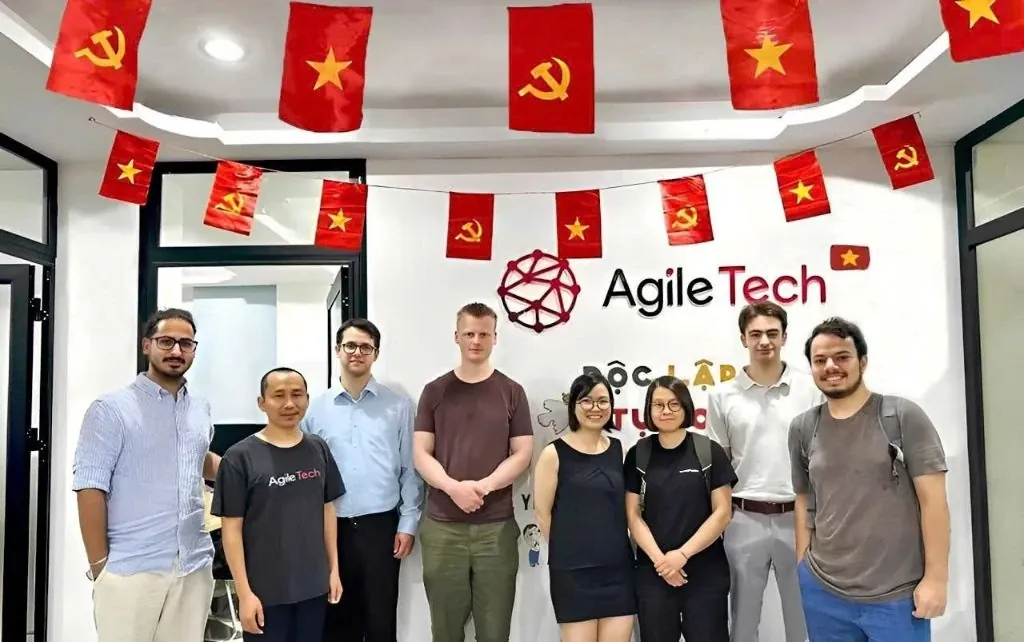
The AgileTech Vietnam team standing together in front of the office logo wall

Consult Industry Specialists

Connect with us today to discuss your software development needs and discover how our tailored outsourcing services can propel your business forward.

Start a conversation
AgileTech Vietnam team at the office

Cookie settings

Strictly necessary storage keeps the site working and remembers this choice. Everything else is off until you switch it on, wherever you are in the world. Only one optional category has anything behind it today: External content, which covers the Google map of our Hanoi office on the Contact page.

Wherever you are. We apply one standard to everyone: nothing outside strictly necessary storage runs until you allow it. That meets the EU and UK requirement for prior consent, the notification and consent requirements of Singapore's PDPA, and US state privacy law. You can withdraw or change your choice at any time, as easily as you gave it, from Cookie settings in the footer.

If you are in the United States. We do not sell your personal information and we do not share it for cross-context behavioural advertising, so there is nothing to opt out of. We still honour an opt-out preference signal from your browser: if your browser sends Global Privacy Control, the optional categories stay off without you having to do anything.

Full detail, including the name and lifetime of the one cookie we set, is in the Cookie Policy.